
4.11.08
On Election Day
15.10.08
Sunday's C-Span Opportunity: 3rd-Party Candidates Debate

From Common Dreams.
WASHINGTON - Third-party presidential candidates finally will have their own debate: at 8 p.m. Sunday at Columbia University in New York.
The debate, which will be announced Wednesday, will include at least three of the four third-party candidates - independent Ralph Nader, the Green Party's Cynthia McKinney and the Constitution Party's Chuck Baldwin. Libertarian Party nominee Bob Barr said he has a scheduling conflict, but debate organizers say he wanted to appear only with Nader. (Democratic nominee Barack Obama and Republican nominee John McCain are also invited.)
Nader and Barr are on the ballot in 45 states, while the Green Party is on 31 state ballots and the Constitution Party is on the ballot in 37 states. Nader and McKinney also are on the District of Columbia ballot.
Organizers say the debate is an important exercise in democracy, especially because the debates sponsored by the Commission on Presidential Debates (the last of which is Wednesday night) exclude candidates scoring below 15 percent in national polls. Nader, the best known of the candidates, has an average of 2.5 percent in recent national polls, according to realclearpolitics.com, while Barr averages 1.5 percent.
Nader maintains that if he could get into the debates run by the Commission on Presidential Debates, his numbers would immediately climb because "two-thirds of the people don't know we're running."
"It's a Catch-22."
Nader describes the debate commission as "a two-party dictatorial company that doesn't want anybody else on the stage." The commission, created in 1987, is a corporation headed by two former chairs of the Democratic and Republican parties.
But third-party critics of the system recently got some traction: the second of the presidential debates prompted a chorus of criticism of the "boring" format and the lack of follow-up questions.
Nader also will give the issue more visibility at a rally to open the debates Wednesday night at New York's historic Cooper Union Great Hall, where presidential candidates back to Abraham Lincoln have spoken.
The format for Sunday's third-party debate is still being finalized. It will be moderated by Pacifica radio host Amy Goodman. The issues promoted by the candidates strike a different chord from the major party standard-bearers - all four are against the $700 billion economic bailout and all oppose the Iraq war.
In addition, each has his or her own agenda: Nader rails against corporate greed while McKinney promotes environmental causes. The Libertarian Party is a critic of monetary policy and likes to invoke a return to the gold standard. Baldwin of the Constitution Party represents a conservative, small government, anti-abortion party that wants to "restore the government to its biblical foundations."
The third-party debate will be streamed at www.thirdpartyticket.com and will be shown on C-Span.
25.9.08

16.9.08
Amnesty International's Response to the Police Repression in St. Paul RNC
For immediate release:
Friday, September 5, 2008
Contact: AIUSA media office
202-544-0200 x302
The organization’s concerns arise from media reports, video and photographic images which appear to show police officers deploying unnecessary and disproportionate use of non-lethal weapons on non-violent protestors marching through the streets or congregating outside the arena where the Convention was being held.
Amnesty International urges that an inquiry be carried out promptly, that its findings and recommendations be made public in a timely manner. If the force used is found to have been excessive and to have contravened the principles of necessity and proportionality, then those involved should be disciplined, measures put in place and training given to ensure future policing operations conform to international standards.
Police are reported to have fired rubber bullets and used batons, pepper spray, tear gas canisters and concussion grenades on peaceful demonstrators and journalists. Amnesty International has also received unconfirmed reports that some of those arrested during the demonstrations may have been ill-treated while held at Ramsey county jail.
Amnesty International is also concerned at reports that several journalists who were covering the RNC were arbitrarily arrested while filming and reporting on the demonstrations. They include host of independent news program Democracy Now!, Amy Goodman, and two of the program’s producers, Sharif Abdel Kouddous and Nicole Salazar, who were both allegedly subjected to violence during their arrest. A photographer for the Associated Press (AP) and other journalists were also arrested while covering the demonstrations.
Kouddous described his arrest to media, “…two or three police officers tackled me. They threw me violently against a wall. Then they threw me to the ground. I was kicked in the chest several times. A police officer ground his knee into my back…I was also, the entire time, telling them, ‘I’m media. I’m press….,’ but…that didn’t seem to matter at all.”
Amnesty International recognizes the challenges involved in policing large scale demonstrations and that some protestors may have been involved in acts of violence or obstruction. However, some of the police actions appear to have breached United Nations (U.N.) standards on the use of force by law enforcement officials. These stipulate, among other things, that force should be used only as a last resort, in proportion to the threat posed, and should be designed to minimize damage or injury. Some of the treatment also appears to have contravened U.S. laws and guidelines on the use of force. The U.N. standards also stress that everyone is allowed to participate in lawful and peaceful assemblies, in accordance with the principles embodied in the Universal Declaration of Human Rights.
For more information, please contact the AIUSA media office at 202-544-0200 x302 or visit our website at www.amnestyusa.org.
15.9.08
"This is Your Nation on White Privilege"
9/13/08
For those who still can't grasp the concept of white privilege, or who are looking for some easy-to-understand examples of it, perhaps this list will help.
White privilege is when you can get pregnant at seventeen like Bristol Palin and everyone is quick to insist that your life and that of your family is a personal matter, and that no one has a right to judge you or your parents, because "every family has challenges," even as black and Latino families with similar "challenges" are regularly typified as irresponsible, pathological and arbiters of social decay.
White privilege is when you can call yourself a "fuckin' redneck," like Bristol Palin's boyfriend does, and talk about how if anyone messes with you, you'll "kick their fuckin' ass," and talk about how you like to "shoot shit" for fun, and still be viewed as a responsible, all-American boy (and a great son-in-law to be) rather than a thug.
White privilege is when you can attend four different colleges in six years like Sarah Palin did (one of which you basically failed out of, then returned to after making up some coursework at a community college), and no one questions your intelligence or commitment to achievement, whereas a person of color who did this would be viewed as unfit for college, and probably someone who only got in in the first place because of affirmative action.
White privilege is when you can claim that being mayor of a town smaller than most medium-sized colleges, and then Governor of a state with about the same number of people as the lower fifth of the island of Manhattan, makes you ready to potentially be president, and people don't all piss on themselves with laughter, while being a black U.S. Senator, two-term state Senator, and constitutional law scholar, means you're "untested."
White privilege is being able to say that you support the words "under God" in the pledge of allegiance because "if it was good enough for the founding fathers, it's good enough for me," and not be immediately disqualified from holding office--since, after all, the pledge was written in the late 1800s and the "under God" part wasn't added until the 1950s--while believing that reading accused criminals and terrorists their rights (because, ya know, the Constitution, which you used to teach at a prestigious law school requires it), is a dangerous and silly idea only supported by mushy liberals.
White privilege is being able to be a gun enthusiast and not make people immediately scared of you.
White privilege is being able to have a husband who was a member of an extremist political party that wants your state to secede from the Union, and whose motto is "Alaska first," and no one questions your patriotism or that of your family, while if you're black and your spouse merely fails to come to a 9/11 memorial so she can be home with her kids on the first day of school, people immediately think she's being disrespectful.
White privilege is being able to make fun of community organizers and the work they do--like, among other things, fight for the right of women to vote, or for civil rights, or the 8-hour workday, or an end to child labor--and people think you're being pithy and tough, but if you merely question the experience of a small town mayor and 18-month governor with no foreign policy expertise beyond a class she took in college and the fact that she lives close to Russia--you're somehow being mean, or even sexist.
White privilege is being able to convince white women who don't even agree with you on any substantive issue to vote for you and your running mate anyway, because suddenly your presence on the ticket has inspired confidence in these same white women, and made them give your party a "second look."
White privilege is being able to fire people who didn't support your political campaigns and not be accused of abusing your power or being a typical politician who engages in favoritism, while being black and merely knowing some folks from the old-line political machines in Chicago means you must be corrupt.
White privilege is when you can take nearly twenty-four hours to get to a hospital after beginning to leak amniotic fluid, and still be viewed as a great mom whose commitment to her children is unquestionable, and whose "next door neighbor" qualities make her ready to be VP, while if you're a black candidate for president and you let your children be interviewed for a few seconds on TV, you're irresponsibly exploiting them.
White privilege is being able to give a 36 minute speech in which you talk about lipstick and make fun of your opponent, while laying out no substantive policy positions on any issue at all, and still manage to be considered a legitimate candidate, while a black person who gives an hour speech the week before, in which he lays out specific policy proposals on several issues, is still criticized for being too vague about what he would do if elected.
White privilege is being able to attend churches over the years whose pastors say that people who voted for John Kerry or merely criticize George W. Bush are going to hell, and that the U.S. is an explicitly Christian nation and the job of Christians is to bring Christian theological principles into government, and who bring in speakers who say the conflict in the Middle East is God's punishment on Jews for rejecting Jesus, and everyone can still think you're just a good church-going Christian, but if you're black and friends with a black pastor who has noted (as have Colin Powell and the U.S. Department of Defense) that terrorist attacks are often the result of U.S. foreign policy and who talks about the history of racism and its effect on black people, you're an extremist who probably hates America.
White privilege is not knowing what the Bush Doctrine is when asked by a reporter, and then people get angry at the reporter for asking you such a "trick question," while being black and merely refusing to give one-word answers to the queries of Bill O'Reilly means you're dodging the question, or trying to seem overly intellectual and nuanced.
White privilege is being able to go to a prestigious prep school, then to Yale and then Harvard Business school, and yet, still be seen as just an average guy (George W. Bush) while being black, going to a prestigious prep school, then Occidental College, then Columbia, and then to Harvard Law, makes you "uppity," and a snob who probably looks down on regular folks.
White privilege is being able to graduate near the bottom of your college class (McCain), or graduate with a C average from Yale (W.) and that's OK, and you're cut out to be president, but if you're black and you graduate near the top of your class from Harvard Law, you can't be trusted to make good decisions in office.
White privilege is being able to dump your first wife after she's disfigured in a car crash so you can take up with a multi-millionaire beauty queen (who you go on to call the c-word in public) and still be thought of as a man of strong family values, while if you're black and married for nearly twenty years to the same woman, your family is viewed as un-American and your gestures of affection for each other are called "terrorist fist bumps."
White privilege is being able to sing a song about bombing Iran and still be viewed as a sober and rational statesman, with the maturity to be president, while being black and suggesting that the U.S. should speak with other nations, even when we have disagreements with them, makes you "dangerously naive and immature."
White privilege is being able to claim your experience as a POW has anything at all to do with your fitness for president, while being black and experiencing racism and an absent father is apparently among the "lesser adversities" faced by other politicians, as Sarah Palin explained in her convention speech.
And finally, white privilege is the only thing that could possibly allow someone to become president when he has voted with George W. Bush 90 percent of the time, even as unemployment is skyrocketing, people are losing their homes, inflation is rising, and the U.S. is increasingly isolated from world opinion, just because white voters aren't sure about that whole "change" thing. Ya know, it's just too vague and ill-defined, unlike, say, four more years of the same, which is very concrete and certain.
White privilege is, in short, the problem.
26.8.08
"If voting changed anything, they'd outlaw it." Or just rig the elections.
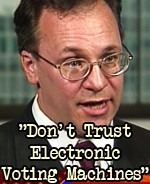 From an Uprising Radio segment:
A prominent data security expert and self-described life-long Republican has said that Diebold voting machines can never be trusted. In a 2006 interview, Steven Spoonamore says that the 2004 election was stolen and that Diebold voting machines are designed to steal elections. Spoonamore is a renowned expert having worked with the US Army and the Department of Homeland Security on cyber-security and other processes. He has worked extensively in private industry as well, and has testified in front of both houses of Congress about secure communications and emergency systems used in communications. His analysis of Diebold machines is a damning blow to a civil suit pending in Ohio relating to the 2004 elections. In fact Spoonamore is an expert witness in the case. What does this mean for the 2008 elections? How can voting irregularities that marred both the last Presidential elections be avoided in this coming election?
GUEST: Cliff Arnebeck, expert in election politics, and attorney with election-related civil suit in Ohio
22.8.08
The Conquest by Presidentialism
You have to hand it to John McCain—his campaign ads are (inadvertently) the most incisive commentary on the death of Jeffersonian democracy ever broadcast.
Superficially, they lambaste Barack Obama’s worshipful crowds and messianic promises that a heavenly “light will shine down” on his candidacy. But what the ads really lampoon is what Vanderbilt professor Dana Nelson calls presidentialism: our paternalistic view that presidents are godlike saviors—and therefore democracy’s only important figures.
“The once-every-four-years hope for the lever pull sensation of democratic power blinds people to the opportunities for democratic representation, deliberation, activism and change that surrounds us in local elections,” she writes in her new book, “Bad for Democracy: How the Presidency Undermines the Power of the People.”
In a country whose anti-royalist founders constitutionally constrained executive authority, what explains the metastatic growth of presidentialism? The evisceration of journalism and social movements.
The media’s Watergate triumph sired the current Age of Stenography. With personal glory the new priority, correspondents figured out that transcribing White House prognostication is a far easier way to gain notoriety than Woodward and Bernstein’s shoe-leather investigations. The result is journalism run by grotesque sloth and vapid speculation—the kind exemplified by The New York Times’ top three political correspondents this week. As inflation hit crisis levels and the Russia-Georgia conflict inched the planet toward World War III, these “reporters” devoted a stunning 2,148 words to fact-free guesses about selections for vice president—a position with no power and zero impact on ordinary people’s lives.
Media consolidation and cost-cutting have sped up this decline, turning many local news outlets into collages of wire copy and presidential punditry from D.C. bureaus. Meanwhile, the 21st century’s most celebrated model of “grass-roots” movement-building is MoveOn.org—a top-down group whose primary function is to land stories about itself in Washington gossip rags and send e-mail spam about presidential candidates.
The resulting noise reiterates one message: The only thing that matters is 1600 Pennsylvania Ave.
Why is this dangerous? First and foremost, by ignoring local elections and issue-based organizing in favor of presidential politics, activists make presidential progress less likely. “Even the best presidents need social movements to accomplish transformational change,” warns community activist Deepak Bhargava in The Nation magazine’s latest White House-centric edition. “FDR could not have succeeded without the agitation of the unemployed workers’ councils and the unions, and LBJ’s greatest accomplishments were made possible by the civil rights movement.”
Worse, presidentialism leads us to ignore the arenas where issues are already being sorted out.
For example, how many of the Democratic convention delegates incensed by the Obama-McCain energy brouhaha have any idea that just beyond Denver’s Rocky Mountain horizon, a battle over Colorado’s massive gas reserves will more immediately impact the national energy crisis than the inane presidential back-and-forth about offshore drilling? Better yet, how many Democratic enthusiasts donning Obama T-shirts know who their state representative or city council member is—or even what a state legislature or city council does?
In his upcoming book, “You Can’t Be President,” journalist John MacArthur ponders the depressing answers to these kinds of questions, reminding readers of Alexis de Tocqueville’s 19th-century writing.
“It is in vain to summon a people, which has been rendered so dependent on the central power, to choose from time to time the representatives of that power,” he observed. “This rare and brief exercise of their free choice, however important it may be, will not prevent them from gradually losing the faculties of thinking, feeling and acting for themselves, and thus gradually falling below the level of humanity.”
Published 168 years ago, the passage is a prescient warning as the upcoming Democratic and Republican conventions toast presidentialism’s conquest of democracy in America.
From here.


 Posts
Posts

